Pixel-Art Crochet — Tapestry vs. Graphgan vs. Corner-to-Corner
Three different ways to turn a pixel-grid chart into a finished crochet piece. Each has a different look, a different feel, and a different ideal use case. Here's how to pick.
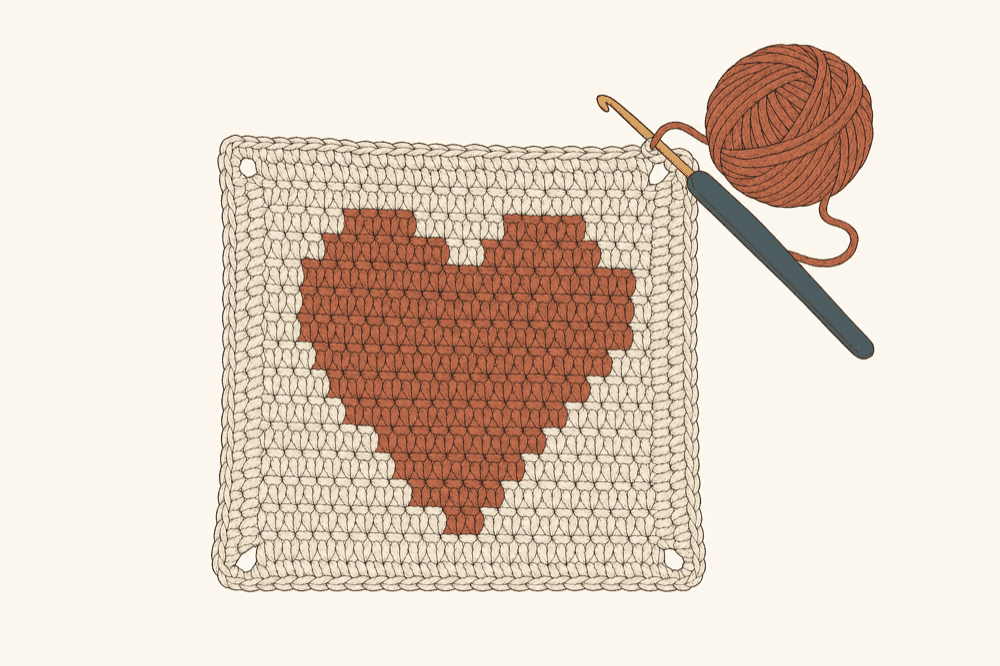
You've got a chart. You want to crochet it. There are three serious techniques to choose from, each with a different visual register and a different ideal use case.
Tapestry crochet
Mechanically: every cell of the chart is one single crochet (sc) in the indicated color. You carry the unused colors inside the stitch — they form a hidden core that the active color wraps around. No floats on the back; the fabric is reversible.
Visual register: dense, sharp, slightly textured. Looks like woven tapestry. Stitches are square.
Ideal use case: bags, baskets, hats, dense small accessories. The fabric is stiff — great for items that should hold their shape, less great for soft drape.
Difficulty: medium. The biggest learning curve is managing yarn tension as you switch colors. Yarn-overs need to be deliberate.
Graphgan (or "graphghan")
Mechanically: every cell is one single crochet (or sometimes one half-double crochet). Unused colors are not carried — you bobble them at the back as floats, similar to stranded knit colorwork. Or you can drop and rejoin colors, which means many ends to weave in.
Visual register: similar to tapestry but with slightly more contrast in the colors (no muting from carried strands underneath). Stitches are square.
Ideal use case: large blankets, throws, wall hangings. Where the back doesn't need to be pretty and the fabric can be slightly stretchier than tapestry.
Difficulty: medium-easy. Most beginners pick this for their first chart project — the technique is simpler than tapestry, but the finishing (weaving in ends) is tedious.
Corner-to-corner (C2C)
Mechanically: you work diagonal squares from one corner to the opposite corner, building up the chart on a 45° axis. Each "square" is a tiny granny square (3 dc + ch). Color changes happen between squares.
Visual register: pixelated, diamond-grid feel. The pixel-grid axis runs at 45° to the photographed image. Slight stair-step on diagonal edges.
Ideal use case: large blankets, especially when you want to work fast. C2C is the fastest way to crochet a colorwork chart. You can finish a 60×60 graphgan-equivalent in C2C in roughly 70% of the time.
Difficulty: easy. Each row only changes by one square at a time, so the technique is repetitive and forgiving.
Side-by-side
| Property | Tapestry | Graphgan | C2C | |---|---|---|---| | Stitch | sc | sc / hdc | mini granny | | Carries unused yarn? | yes | optional | no | | Reversible? | yes | no | no | | Stiff or drapey? | stiff | medium | soft | | Speed (compared) | slowest | medium | fastest | | Best for | bags, baskets, hats | medium blankets | large throws | | Best at small scale? | yes | medium | no |
Which to pick
If you're making a bag or basket: tapestry, no question.
If you're making a large blanket for the first time: C2C. Finish faster, learn the chart-following discipline, then graduate to tapestry if you want crisper detail.
If you're making a medium blanket with high pictorial detail: graphgan. Smaller scale than C2C, but cleaner edge lines.
If you're making a wearable garment with a colorwork yoke: tapestry, applied as a panel and seamed in. Knit colorwork is technically better here, but if you're committed to crochet, tapestry is the answer.
Output the chart
All three techniques can read a chart in the same format. The StitchingLab converter outputs a chart you can crochet in any of the three styles — pick "Tapestry crochet" for the cleanest grid output, then choose your technique at the hook.
Try the converter