How to Substitute Yarn in Any Pattern (Without Ruining It)
Substituting yarn is one of crochet's most useful skills and one of its most common project-killers. Here's the disciplined way to do it.
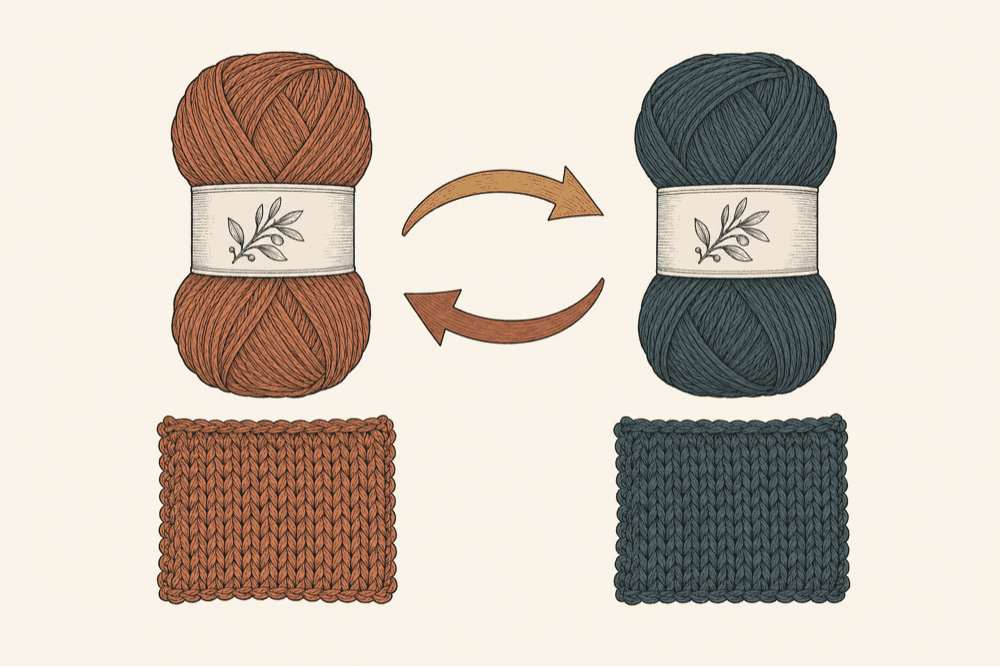
Substituting yarn is one of crochet's most useful skills and one of its most common project-killers. The pattern says Yarn X. You want to use Yarn Y because it's cheaper, in stock, prettier, or you have it in your stash. Here's how to do it without disaster.
Match these in order
1. Weight category (CYC 0–7)
Non-negotiable. A worsted pattern needs a worsted yarn. Substituting one weight category up or down requires redrawing the entire pattern — almost never worth it.
Within a weight category, you have flexibility — DK and sport are close enough that hook adjustment usually fixes the gap. Worsted and aran are usually interchangeable. Bulky and super bulky are not.
2. Gauge
This is where most substitutions fail. Two yarns at the same CYC weight can produce different gauges depending on their fiber, ply, and twist. Always swatch. A 4×4-inch swatch with the substitute yarn at the pattern's recommended hook size, then compare to the pattern's stated gauge.
If your gauge is too tight (more stitches per inch than the pattern), go up a hook size. Too loose, go down. If you can't match gauge after two adjustments, the substitute yarn isn't going to work for that pattern.
3. Fiber
Fiber drives drape, warmth, washability, and wearability. The most common substitution disasters:
- Acrylic for wool (saving money). The pattern's gauge usually adapts but the finished fabric reads stiffer. Bad for sweaters that need to drape; fine for blankets.
- Cotton for wool (warmth-tolerance reasons). Cotton has no stretch and no memory. A cotton-substitute sweater will sag at the shoulders. Better for non-fitted items.
- Wool for cotton (premium upgrade). Wool blooms and softens on washing; the substitute may feel right out of the skein and then change in wash. Swatch and block the swatch.
4. Yardage per skein
Calculate the total yardage the pattern requires (number of pattern skeins × pattern yardage per skein), then divide by your substitute's yardage per skein. Round up. Always buy one extra.
5. Texture
Some patterns are designed for a specific texture: smooth merino for cable definition, fuzzy mohair for cloud-like cowls, slubby cotton for rustic baskets. Substituting a smooth yarn for a fuzzy one changes the entire visual character even when gauge matches. Hold the substitute next to the pattern photo. If they look unrelated, they probably are.
The swatching protocol
A swatch is a small experiment that saves you from a large failure. The protocol:
- With the substitute yarn, work a 6×6-inch square in the pattern's primary stitch, at the pattern's recommended hook size.
- Wash and block it the way you'll wash and block the finished item. This is where wool blooms, acrylic relaxes, cotton shrinks. Your finished fabric is what comes out of this step.
- Lay it flat. Measure 4×4 inches in the middle and count stitches and rows. Compare to pattern gauge.
- If off, adjust hook size and re-swatch.
Yes, this takes an evening. The alternative is finishing a sweater that doesn't fit. The math is in your favor.
When substitution is actually a bad idea
- The pattern is fitted (sweater, hat, gloves) and you can't match gauge after two attempts.
- The pattern uses a specialty technique (mosaic, brioche, cabled colorwork) that depends on the yarn's specific texture.
- The pattern's designer has a known opinion about substitution and says "do not substitute."
In all three cases: spend the extra money on the original yarn, or pick a different pattern.
Tools
The StitchingLab yarn database lets you filter by weight category and fiber to find substitutes that match a pattern's specs. Or run the converter with your substitute yarn brand selected — the materials calculation will tell you if quantities work.
Try the converter