How to Read a Crochet Chart Pattern (with Examples)
Crochet chart patterns look intimidating but they're a clearer way to follow a pattern than written rows. Here's exactly how to read one — symbols, direction, and where to start.
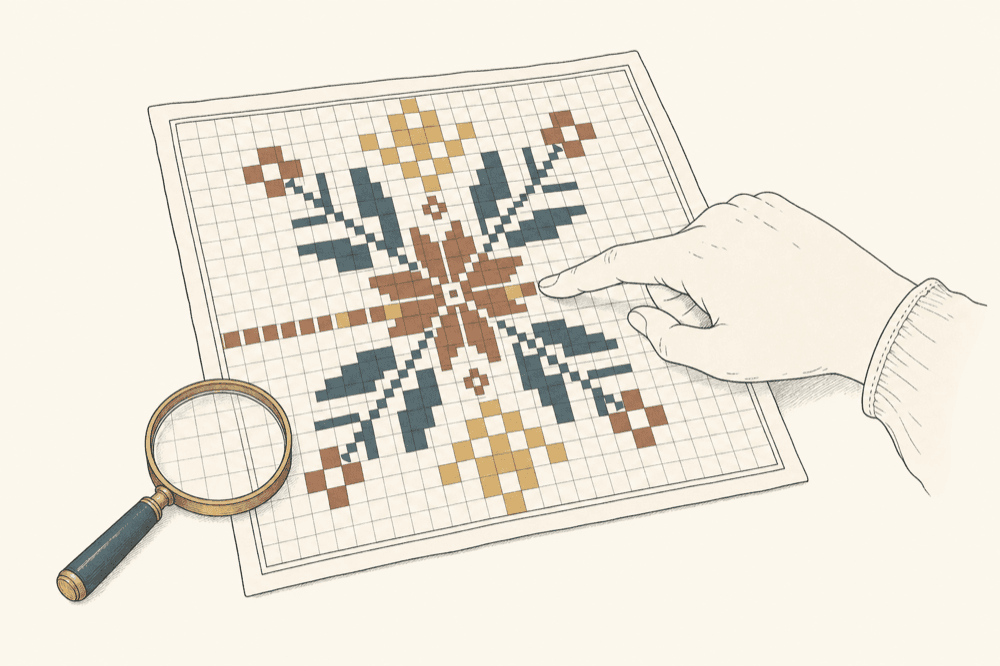
A chart is a small map of stitches. Once you can read one, you'll never go back to row-by-row written patterns for color-block work — charts are denser, faster to follow, and far more forgiving when you lose your place.
What's actually on the page
Three things, always: a symbol key, a grid, and a direction marker.
The grid is your pattern, one cell per stitch. Each cell holds a symbol — a small pictogram that represents a single crochet stitch. The symbol key (sometimes called a stitch key or legend) tells you what each pictogram means in your pattern's language.
For colorwork — tapestry crochet, filet, cross-stitch, knit colorwork — the cell often holds a color instead of a symbol. The key tells you which yarn maps to which color.
Read direction
Charts are read from the bottom up. Row one is the lowest row on the page, then you work upward.
Within a row, direction depends on the stitch type:
- Crochet (worked in rows, turning each row): read row one right to left (assuming you're right-handed; left-handed crocheters read left to right). Then turn your work and read row two in the opposite direction. Charts often draw an arrow at the start of each row to make this explicit.
- Crochet in the round: every row reads in the same direction (usually counter-clockwise from the top, looking down at the work).
- Cross-stitch: read consistently. Doesn't matter where you start.
- Knit colorwork: same as crochet — turn at the end of each row if knit flat. In the round, every row reads the same direction.
The symbol key
The Craft Yarn Council symbol set is the closest thing crochet has to a universal language. It covers the major stitches: chain (a horizontal oval), slip stitch (a small dot), single crochet (an X), half double crochet (a T with a horizontal line), double crochet (a T with one slash), treble (a T with two slashes), and so on. The "more slashes" pattern is consistent and intuitive once you've seen it three times.
Pattern designers may add their own symbols for specialty stitches — bobbles, popcorns, V-stitches, picots. The key always defines them.
Color charts
When a chart uses color instead of stitch symbols, every cell is a single stitch in the indicated yarn. The shape of the cell tells you:
- Square cells: probably tapestry crochet or knit colorwork. Each square = one stitch worked in that color.
- Rectangular cells (taller than wide): probably cross-stitch on Aida cloth.
- Open vs. solid filled cells with no other symbols: filet crochet. Solid = filled square (3 dc), open = mesh (1 dc, ch 2).
A worked example
Let's say you have a 4×4 tapestry chart with three colors — A (cream), B (terracotta), C (charcoal):
Row 4 │ C │ A │ B │ A │
Row 3 │ A │ B │ C │ B │
Row 2 │ A │ B │ C │ B │
Row 1 │ A │ A │ A │ B │
Right-handed, working flat with turning rows: row 1 reads right to left, so you'd work A, A, A, B (single crochet in each of the four stitches across, ending with one B). Turn. Row 2 reads left to right: B, C, B, A. Continue turning and reversing direction every row.
That same chart in SLPN would be SLPN/1/T/4x4/3:F5F0E1,B45F3F,3A3935/AAABABCBABCBCABA — which the StitchingLab converter outputs directly when you upload an image.
Where to start
Find the starting marker in the bottom-right corner (or bottom-left for lefties). Some charts use a small arrow; others use a dot. Worst case, find the row label "Row 1" and start at the right end of that row.
Count your foundation chain before you start. In tapestry crochet, that's typically the chart width plus one (the turning chain). Cross-stitch usually starts in the center and works out, but if you're following a chart with edge markers, start in the corner the chart specifies.
When charts beat written patterns
Charts are clearer than written patterns when:
- The pattern has many color changes per row.
- The motif is geometric or symmetrical — your eye can track the picture faster than the prose.
- You're tired and lose your place easily.
- You're working in a language you don't read fluently — symbols are language-neutral.
Try one yourself
Want a chart you can actually read? Drop a photo into the StitchingLab converter — we'll output a chart, a materials list, and a copyable pattern code. The chart preview is exactly the format described above.
Try the converter