Filet Crochet for Beginners — A Complete Guide
Filet crochet is the most underrated form of crochet. Two stitches, a chart, and you're making heirloom-grade pictorial pieces. Here's everything you need.
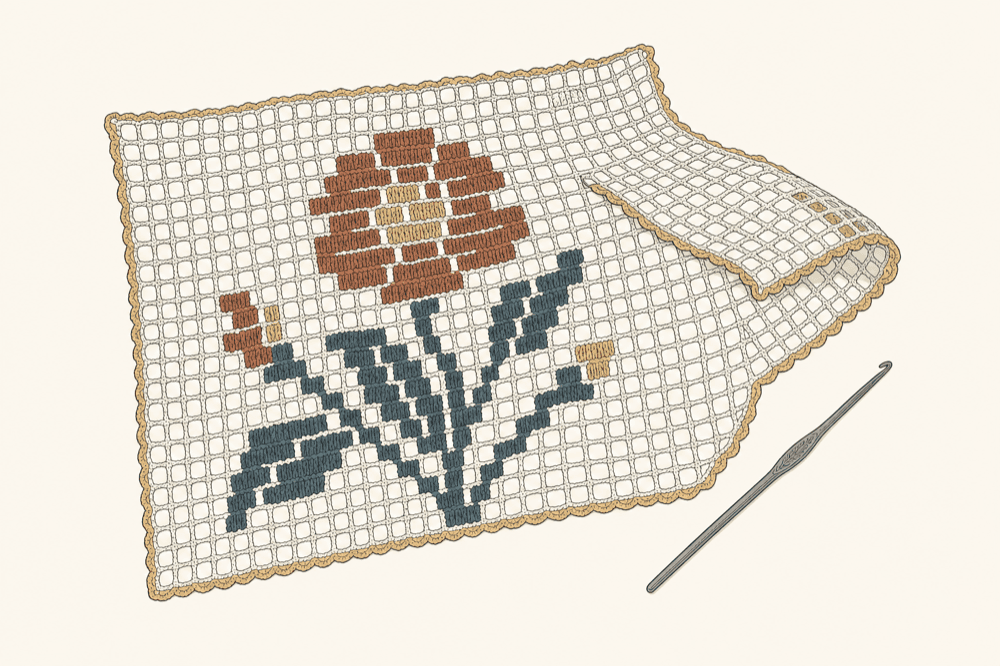
Filet crochet is the most underrated form of crochet. Two stitches — that's it. No specialty techniques, no pattern languages, no row counters. You're working a chart of filled blocks and open mesh, and the picture emerges. The visual register is closer to engraving than to typical "crochet aesthetic" — clean, graphic, restrained.
What it is, mechanically
Every cell in a filet chart is one of two states:
- Block (filled): three double crochets worked back-to-back-to-back.
- Space (open / mesh): one double crochet, then chain 2 to skip the next stitch.
That's the entire grammar. A filet chart is a binary image: 1s and 0s, expressed as blocks and spaces.
You work the chart in rows. Right-handed, you read row 1 right-to-left, work it across, turn, then read row 2 left-to-right. Each row is a horizontal strip of the picture.
Why it produces such striking results
The mesh / block contrast is high. White mesh on a colored background reads almost like cut paper. The geometry is sharp — every cell is exactly the same size, so the whole piece feels precise. Vintage filet doilies and runners (Edwardian-era, mostly) used elaborate calligraphic and floral chart patterns and they look as good now as they did 110 years ago.
The materials
- Yarn: traditional filet uses cotton thread (Aunt Lydia's Classic Crochet Thread, size 10 or 20). For larger throws or modern adaptations, use DK or worsted-weight cotton.
- Hook: matched to the yarn. Size 7 or smaller for thread, 4.0–5.5mm for DK / worsted.
- A chart. This is the only thing you can't substitute.
Foundation chain math
For an N-cell-wide chart:
- All-block start: chain
N × 3 + 5(extra 5 = turning chain + first dc base). - All-space start: chain
N × 2 + 5. - Mixed start: chain enough for the worst case. You can leave the unused chains at the end of row 1.
When in doubt, add 5 extra. Cutting them off later is painless.
A small chart to practice
A 6×6 sample with the StitchingLab heart motif:
. # # # # .
# # # # # #
# # # # # #
. # # # # .
. . # # . .
. . . # . .
# = block (3 dc), . = space (dc, ch 2, skip).
Practice this twice. Once you have the rhythm, scaling to a 60×60 chart is just more of the same.
Where filet shines
- Pictorial pieces. Letters, calligraphy, flowers, animals.
- Curtain panels. A filet curtain reads as architectural detail, not "craft."
- Wall hangings. Stiffened with starch and stretched on a frame.
- Yokes and panels in garments. A small filet panel inset into a plain crochet sweater is striking.
Where filet doesn't work
- 3D shaping. Filet is fundamentally a flat-grid technique.
- Soft drape. Filet fabric is structured. For soft drape, look at lightweight thread-weight filet, or pick another stitch.
- Color blocks beyond 2 colors. Filet is binary by definition. For multi-color chart work, use tapestry crochet.
Start with a chart
The easiest way to start is with a chart. We built a free image-to-pattern converter that outputs filet charts directly — drop any high-contrast photograph (a silhouette, a piece of botanical illustration, a typographic letter), pick "Filet" as the stitch type, and you'll get a binary chart sized to your specification. Print it, count along, stitch.
Try the converter