Crochet Hook Sizes — US to mm Conversion (and When to Size Up)
A clean reference for crochet hook sizes — US letters, UK numbers, mm equivalents — plus when and why to size up or down from a pattern.
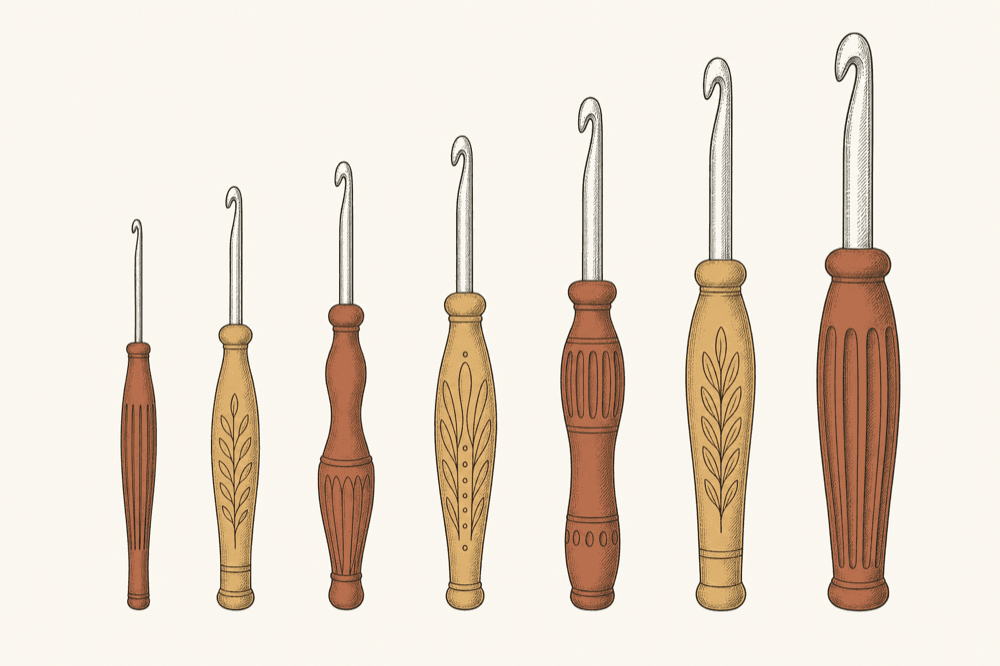
Crochet hook size is measured in three systems that don't quite line up. Here's the table to keep on your phone, plus the practical answer to the question every beginner asks: when do I sine up?
The conversion table
| US | UK | Metric (mm) | |---|---|---| | B-1 | 13 | 2.25 | | C-2 | 12 | 2.75 | | D-3 | 11 | 3.25 | | E-4 | 10 | 3.5 | | F-5 | 9 | 3.75 | | G-6 | 8 | 4.0 | | 7 | 7 | 4.5 | | H-8 | 6 | 5.0 | | I-9 | 5 | 5.5 | | J-10 | 4 | 6.0 | | K-10½ | 3 | 6.5 | | L-11 | 0 | 8.0 | | M/N-13 | 00 | 9.0 | | N/P-15 | 000 | 10.0 | | P/Q | — | 15.0 | | Q | — | 16.0 | | S | — | 19.0 |
The metric measurement is the most useful — it's printed on every hook produced in the last 30 years and it's unambiguous.
Pattern recommends X, you should use Y
Patterns recommend a hook size based on the designer's own gauge with the specified yarn. Your gauge will probably differ — every crocheter has a personal tension that's tighter or looser than the designer's. Adjust the hook size to match the gauge, not to match the printed recommendation.
When to size up (use a bigger hook)
- Your swatch is too tight (more stitches per inch than pattern gauge). Going up one size loosens the fabric.
- You crochet tightly by nature.
- The yarn is splitting at the recommended hook size.
- You want a drapier finished fabric for a wearable item.
When to size down (use a smaller hook)
- Your swatch is too loose.
- You're working amigurumi — denser fabric prevents stuffing showing through. Common rule: drop 1–2 sizes from the yarn band's recommended hook for amigurumi.
- The yarn is fluffy or fuzzy and you want sharper stitch definition.
- You're working filet crochet — denser blocks improve the open/closed mesh contrast.
Hook material matters more than people think
Aluminum, plastic, bamboo, and steel hooks all crochet differently with the same yarn:
- Aluminum is fast and slick. Great for acrylic and cotton.
- Bamboo has more grip — good for slippery yarns (silk, mercerized cotton). Slows you down slightly.
- Plastic (often resin or acrylic) varies. Cheap plastic hooks have rough heads that snag. Decent ones (Furls, Clover Amour, etc.) work well.
- Wood has the most grip — great for very slick yarns. Slowest.
If you're switching brands and your gauge changes, it's the material more than the size.
Ergonomic hooks
If your hand cramps on long sessions, an ergonomic hook (fat handle, often soft-grip rubber) is a real upgrade. They cost 3–5× a basic aluminum hook but they pay back in less hand fatigue. The standard go-to is a Clover Amour or Furls Streamline.
Note: the ergonomic shape doesn't change the hook size. An ergonomic 5.0 mm is the same tool diameter as a basic 5.0 mm.
Tools
Need to translate between systems quickly? Our US ↔ UK converter has the full table for stitch names, hook sizes, and yarn weights.
If you want one set that covers every size on this page, the Clover Amour hook set (Amazon) is the one we reach for.
StitchingLab earns a commission when you buy through our links. As an Amazon Associate, we earn from qualifying purchases.
Try the converter